



Insights & Observations
Economic, Public Policy, and Fed Developments
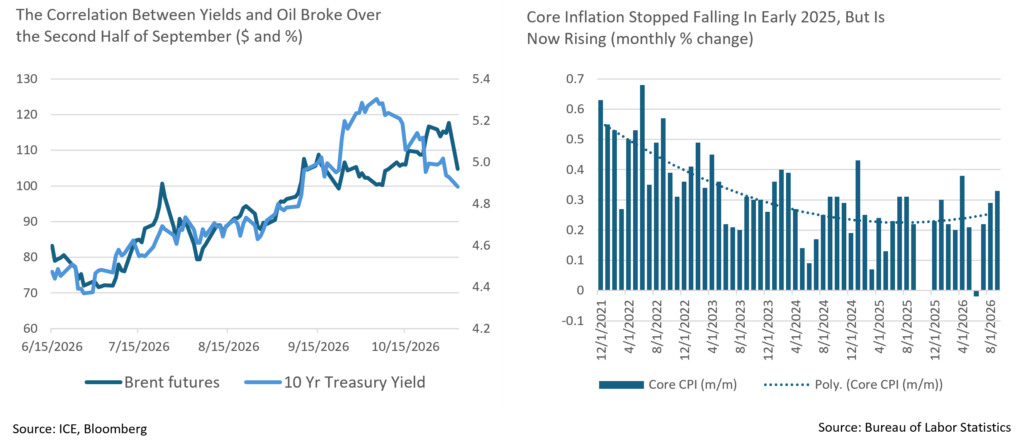
- Despite some stiff competition, we’d argue the breakdown in correlation between Brent oil and the 10Yr UST was the biggest economic news of the past month. The treasury curve had been trading tightly with the price of oil since the summer, but after September’s runup in rates following a break in technical resistance, a sharp selloff in AI stocks on overinvestment fears caused Treasuries to catch a bid. The 10Yr is sitting back under 5%, and we’re reassured to see it behaving in a more normalized manner.
- It would have been more reassuring still had Fed Chair Kevin Warsh not then tried to attribute this return to normalcy to the Fed’s September 25bps hike. In his October press conference, Warsh managed to partially undo some of the good he had done in September, in our eyes. He struck a dovish tone and attributed the above-mentioned normalization in yields to the Fed’s intervention, not AI concerns. He also stressed that he was happy with how the “spoonful of medicine” the Fed had administered was working through the economy, which given the infamous “long and variable lags” of monetary policy stretches plausibility. This follows an appearance in Thailand where he emphasized a stronger push from the press to more closely focus on monetary policy than he felt necessary. We still believe the Fed will ultimately remain committed to beating inflation, but we think Warsh hurt his credibility and came across a man hoping to change the subject from inflation.
- This is doubly concerning because inflation continues to surprise to the upside. Core CPI in September beat a tenth, +0.3% vs +0.2%, and came within a fraction of rounding to +0.4%. Inflation readings have been volatile but had been steadily falling into 2025; they appear to have bottomed out early that year, however, and have trended upwards since then, even before the war in Iran. One of the reasons we expect further Fed Funds hikes is the trend in inflation data suggests monetary policy likely fell below neutral and became accommodative in 2025, and it may be hard to cut below current levels.
- The Nonfarm Payrolls report at the start of the month missed, 29k vs. an expected 90k. The details of the report were more nuanced. The unemployment rate rose, but it was due to an increase in participation and not a fall in employment. Meanwhile, after a long period of bouncing between 34.2 and 34.3 hours, the average workweek has now been at 34.4 hours for two months. We might take all of this as evidence of healthy labor demand despite the headline miss had not the average hourly earnings missed, +0.1% vs. a consensus +0.3%. That’s still a reasonably healthy +3.0% on a trailing-year basis, comfortably higher than pre-pandemic norms. Earnings are still trending lower, however, and inflation is also higher than pre-pandemic levels, making nominal strength a little less impressive on a real basis.
- America voted in the midterm elections on Tuesday the 4th. Most, if not all, of the races have been settled by this time, and we will discuss election implications in future publications.
Sources: Bloomberg, Bureau of Labor Statistics, and Intercontinental Exchange
Equity News and Notes
A Look At The Markets
- U.S. equity indices delivered mixed results in October, with headline performance masking a meaningful shift beneath the surface. The S&P 500 declined -0.9%, while the technology heavy Nasdaq Composite fell -5.3%, its weakest month since March 2025. In contrast, the DJIA gained +1.7% and the small-cap Russell 2000 edged up +0.5%.
- Notably, the equal-weight S&P 500, which treats every company the same regardless of size, rose +4.9%, outperforming the traditional market-cap weighted index by 590bps. This was its largest monthly outperformance since April 2009. Energy led with a +14.0% gain, followed by the defensive Consumer Staples, Utilities, and Health Care sectors, each up 10% or more. Reinforcing a movement away from recent high growth leadership, Communication Services fell -15.2%, its worst month since April 2022, and Information Technology declined -6.8%. Participation broadened considerably, with nearly 60% of S&P 500 companies trading above their 50-day moving averages by month-end, compared with closer to 20% in late September.
- The primary driver of the month was a shift in how investors evaluated artificial intelligence (“AI”). Early in October, attention centered on whether demand for AI could meet elevated expectations, but by mid-month the focus moved to concern about financing the enormous buildout. Many of the AI momentum darlings sold off hard with semiconductors (SOXX), memory (DRAM), and neocloud (NCLD) falling -17.1%, -20.5%, and -35.3%, respectively.
- In the face of these pressures, broader corporate fundamentals remained solid, with blended S&P 500 Q3 earnings growth of +30.2% and 82% of reporting companies beating estimates. Earnings growth for the “Magnificent 7” (+22.6%) dipped below that of the “other 493” (+32.6%) for the first time since Q4 2022, providing a tailwind for breadth expansion. Nonetheless, high expectations, rising fuel, freight, and memory costs, and growing divergence in consumer spending by income tempered investor enthusiasm.
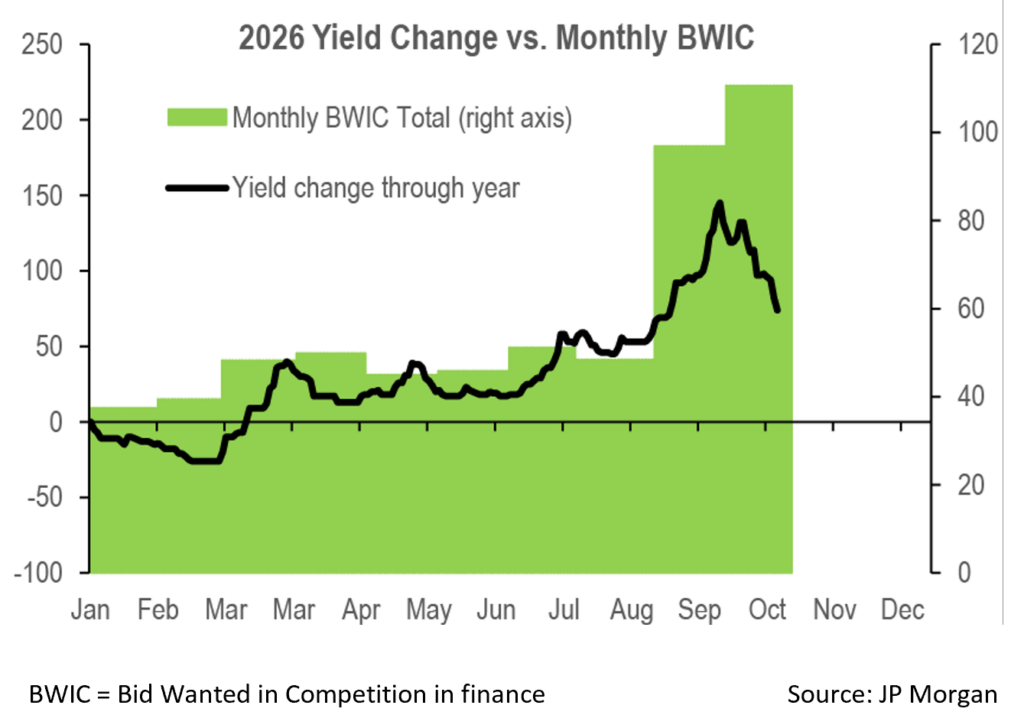
- Markets are digesting a complex macroeconomic and geopolitical backdrop. The 10Yr UST yield reached its highest level since 2002 in early October before strong auction demand and a retreat in technology stocks drove yields down 35bps to 4.92%. Economic data presented a mixed picture with Q3 GDP posting +3.4% annualized growth and retail sales printing above expectations, yet September payrolls rose by just 29,000 and unemployment ticked up to 4.2%. Inflation remains elevated, with core consumer prices rising slightly faster than forecast.
- As expected, the Federal Reserve held rates steady at 3.75-4.0%, though two policymakers dissented in favor of an increase, and futures markets ended the month pricing a 73% probability of a December hike. Energy markets added further volatility, as renewed Middle East tensions and attacks on shipping in the Strait of Hormuz lifted WTI crude +15.2% to more than $100 per barrel even as regional oil exports recovered.
- Investors remain focused on the Fed’s December meeting and the inflation and employment reports that will shape that decision. We are evaluating how technology companies are funding their AI investments and looking for confirmation that this spending will translate into durable cash flow. A sustained broadening of market leadership would be encouraging, though its durability remains to be seen. Importantly, recent weakness in technology reflected a rotation rather than a broad retreat from equities, as investors redirected capital toward defensive and cash-generative businesses. While inflationary and geopolitical risks remain, fundamentals are always important, and a diversified, disciplined approach has served long-term investors well through volatile market environments.
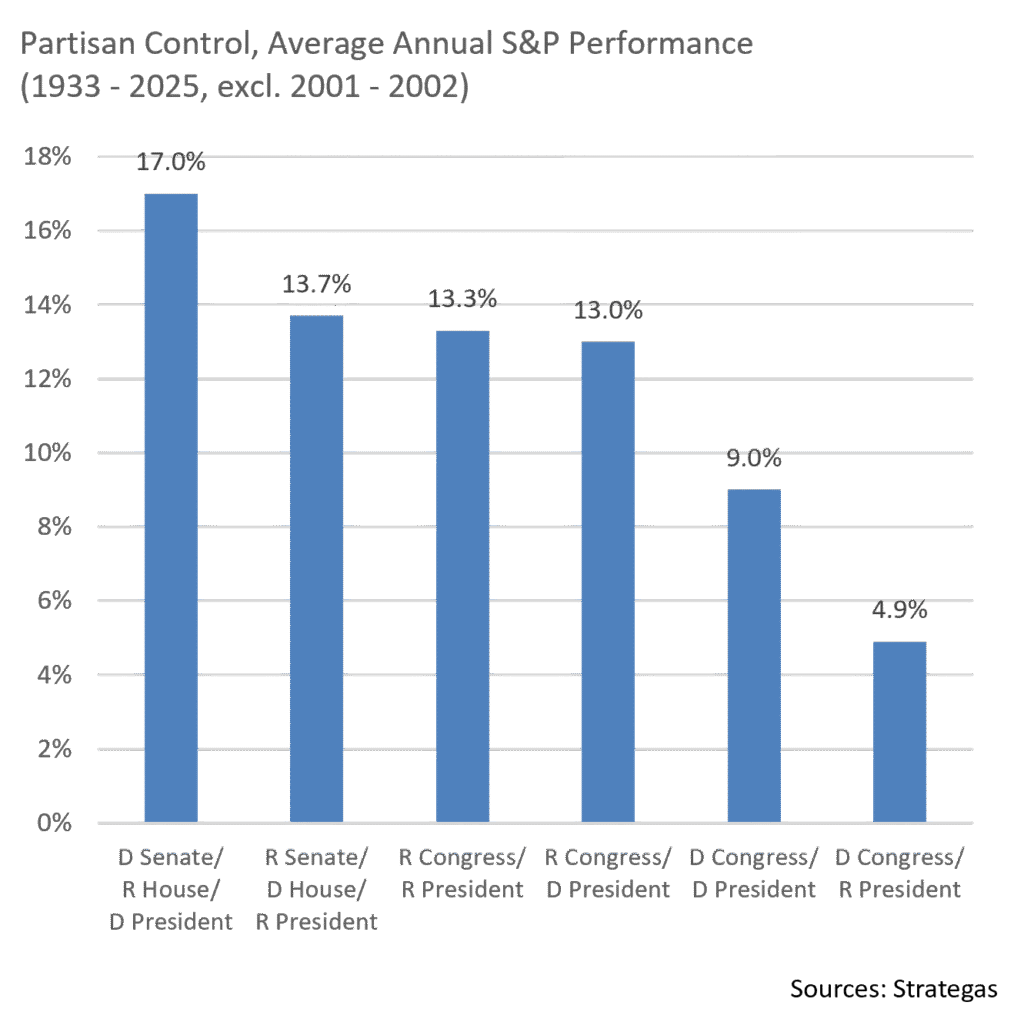
- Finally, we would be remiss not to mention the recent midterms and their potential to influence markets. Gubernatorial races are likely to have the greatest impact on data center buildouts. A divided federal government has historically produced market outperformance regardless of President, due to reduced likelihood of unsettling legislation being passed. Seasonality is an inexact science, but year three of the post-midterms presidential cycle tends to be strong, and broader market performance is likely to remain driven primarily by economic growth, corporate earnings, inflation and Fed policy.
Sources: Bloomberg, FactSet
From the Trading Desk
Municipal Markets
- After the sharp selloff in September, municipal yields started the month at multi-year highs on the back of record primary and secondary market supply.
- Having demonstrated significant value both on an absolute and relative tax-equivalent basis, October saw a significant rally in rates, almost fully retracing the yield increase of the prior month. This produced the best monthly October return since 1980 (JP Morgan) with the Bloomberg Municipal Bond Index gaining +3.85%. Specifically, 1 to 5-yr maturities saw yields drop by 76- 86bps, 7 and 10-yrs by 71bps, 12 to 15-yrs by 64-68bps points, and the long-end closed lower by 32bps.
- The municipal curve bull steepened dramatically as front-end yields fell by over a factor of 2x relative to the long end (80bps vs 32bps). Consequently, the 2-10s steepened by 17 bps, and within that range 2-5s accounted for 12 bps of the move. The 2-30s slope steepened by 56 bps to close at 215 bps, prompting many investors to embrace longer-dated maturities.
- Ratios richened substantially, with all points on the curve tightening by at least 2.75% and the front-end experiencing double digit ratio moves. Specifically, the 2-year got richer by 15%, the 3-year by 12.42%, and the 5-yr by over 10%. Ratios for the 7- and 10-yr portions of the curve fell by 8.7-9% in a descending fashion, and the month closed with most intermediate maturities in the 60-68% range.
- While net municipal fund flows were solidly positive (+$1.1 – $1.7B weekly), there was significant divergence between ETFs and municipal open-end funds. The former was strongly positive while the latter registered redemptions throughout the month on account of tax-loss harvesting trades.
- October saw $45B in long term tax-exempt supply, a slowdown of 7% relative to the prior October. However, on a YTD basis, issuance has increased 6% YoY.
Corporate Markets
- USTs began early October with carryover volatility from September’s rate sell-off on the heels of stronger oil prices, persistent above-target inflation, and deficit concerns. The October 7th FOMC minutes release confirmed a unanimous expectation of hiking rates further before the end of the year. The sell-off began slowly with a rally fully in play later in the month as intermediate and longer rates fell 15–18bps, well above the 3–8bps on the short end. A further rally to end the month took rates even lower and the 10Yr benchmark bond broke through a resistance of 5%. Yields also moved lower following the Federal Reserve’s rate hike pause and overall dovish press conference tone. We expect an additional hike in December and see potential for the curve to steepen over the 2 to 10Yr maturity range.
- The US Investment Grade Market saw some spread widening amid a massive UST rally. The Bloomberg US IG Corporate Index posted a positive total net return for the month with lower UST yields offsetting +7 bp OAS of spread widening. Despite credit underperforming USTs, investment grade fundamentals remained intact despite Fed policy uncertainty, inflation pressure, geopolitical risk, and higher energy prices.
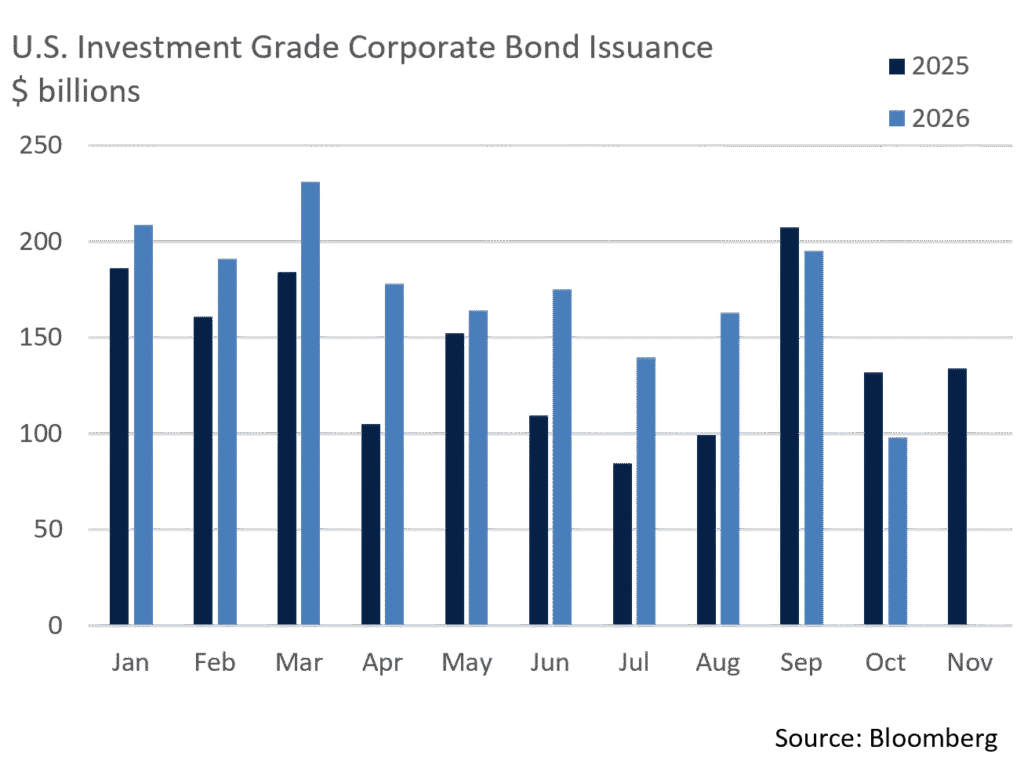
- The primary market set an annual issuance record of $1.76 trillion even as mid-month volatility forced multiple borrowers to stand down. We anticipate a degree of further spread widening as year-end approaches. New issuance is expected to slow somewhat though as fatigue from the AI boom is now impacting buyers.
Sources: Bloomberg, Bond Buyer, Barclays, JP Morgan, and Lipper Inc.
Financial Planning Perspectives
Take a Strategic Approach to Charitable Giving
As the holiday season approaches, many individuals consider making charitable contributions to organizations and causes of importance to them. While supporting these organizations is the main priority, how and when you give can have considerable tax implications. A little planning can help you support the causes you care about while making the most of available tax benefits.
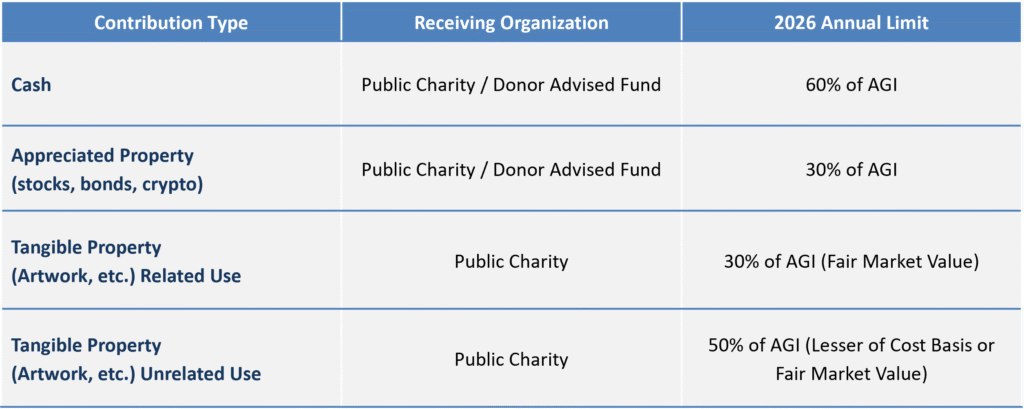
The type of asset you donate can be just as important as the amount of the gift. Donors with highly appreciated securities may want to consider gifting the securities directly rather than selling them and donating cash, as in-kind contributions avoid capital gains taxes.
Gifts of tangible property can also be beneficial from a tax standpoint, although guidance and planning may be needed.
The One Big Beautiful Bill Act introduced provisions surrounding charitable contributions that are effective for the 2026 tax year.
- Those who itemize and make a charitable contribution will only be able to take a deduction to the extent that their contribution exceeds 0.5% of adjusted gross income (“AGI”). For example, a couple with AGI of $400,000 would only be able to deduct donations in excess of $2,000.
- Deductions available to taxpayers in the highest marginal bracket are also now capped to 35%. For example, if a taxpayer in the highest bracket donated $10,000, the value of their deduction would be limited to $3,500.
- Lastly, taxpayers who do not itemize may deduct qualifying cash charitable contributions of up to $1,000 for single filers, or $2,000 for married couples filing jointly.
Charitable giving is a personal decision designed to support the organizations and causes that matter most to you. While it can be tempting to make smaller gifts to many different organizations, narrowing your focus to a select group of charities can enable your contributions to have a greater impact. Tax code provisions make thoughtful planning very important, particularly for higher tax bracket taxpayers. Donors ought to consider not only which organizations they support, but also the timing and amount of their contributions. In some cases, making larger, less frequent gifts offers a more effective approach.
As always, please reach out to your Wealth Manager to discuss charitable giving strategies.
Source: https://www.northerntrust.com/united-states/institute/articles/tax-benefits-charitable-contributions-artwork, https://www.fidelitycharitable.org/articles/obbb-tax-reform.html, https://www.theamericancollege.edu/knowledge-hub/insights/is-it-better-to-give-to-one-charity-or-many, https://www.schwab.com/learn/story/12-tax-smart-charitable-giving-tips
This commentary reflects the opinions of Appleton Partners based on information that we believe to be reliable. It is intended for informational purposes only, and not to suggest any specific performance or results, nor should it be considered investment, financial, tax or other professional advice. It is not an offer or solicitation. Views regarding the economy, securities markets or other specialized areas, like all predictors of future events, cannot be guaranteed to be accurate and may result in economic loss to the investor. While the Adviser believes the outside data sources cited to be credible, it has not independently verified the correctness of any of their inputs or calculations and, therefore, does not warranty the accuracy of any third-party sources or information. Specific securities identified and described may or may not be held in portfolios managed by the Adviser and do not represent all of the securities purchased, sold, or recommended for advisory clients. The reader should not assume that investments in the securities identified and discussed are, were or will be profitable. Any securities identified were selected for illustrative purposes only, as a vehicle for demonstrating investment analysis and decision making. Investment process, strategies, philosophies, allocations, performance composition, target characteristics and other parameters are current as of the date indicated and are subject to change without prior notice. Registration with the SEC should not be construed as an endorsement or an indicator of investment skill, acumen, or experience. Investments in securities are not insured, protected or guaranteed and may result in loss of income and/or principal.