



Insights & Observations
Economic, Public Policy, and Fed Developments
- December’s FOMC meeting offered plenty for market participants to digest despite none of the main elements being surprising. For one, both the statement and Chairman Powell’s press conference made it clear the Fed now expects to be on hold for at least several months. The “dot plot” guided to a cut in 2026 and 2027, though high dispersion and no clear consensus suggests the bigger message is the Fed will be taking a wait and see approach as data comes in. We welcome an extended pause, in part because we see significant distortions in the economic data pertaining to both the maximum employment and price stability sides of the Fed’s dual mandate.
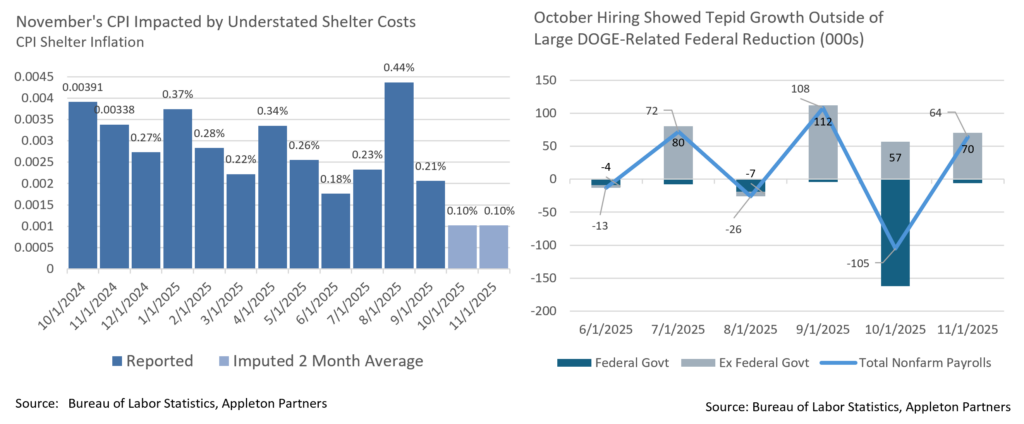
- On the labor front, October’s -105k print was ugly, but we’ve known it would be for months now. The DOGE voluntary severance package would have recipients filing claims at the start of October, so a sharp drop in federal employment was expected. Excluding this -162k decline, the workforce expanded, though at a still soft 57k. There is still room for caution; most of the 270k or so workers who took the package appear to have been unable to find a new job. And, expected or not, the loss of income for 162k consumers will still weigh on aggregate demand. We are not seeing widespread private sector reductions just yet, however, and the private sector is healthier than the jobs report alone suggests.
- Turning to inflation, while the CPI drop to +2.7% headline and +2.6% core looks like significant progress towards the Fed’s +2% objective, the reports’ details warrant caution. By our measure, 0.265 points of the 0.313-point improvement was related to a fall in shelter costs. Except, with BLS closed throughout October, no shelter cost survey was performed. As BLS protocol is to roll forward prior prices when data is missing, this effectively resulted in 0% shelter price inflation over October. While no two-month component price index was released, it’s possible to derive one from the rest of BLS’s published data, yielding a 0.203% increase. This is below the YTD one-month average, implying possible November impacts as well. As shelter inflation is based on a six-month sample, this component will be understated through at least April even without a second shutdown, and with a January 30th stopgap deadline, that’s far from certain. We believe a focus on ex-shelter measures like the Fed’s “Supercore” will become even more important in the first half of 2026 to make sense of inflation data.
- One true surprise from the Fed’s meeting, however, was a resumption of QE in all but name, with the Fed buying Treasury bills to support short term market liquidity. While not intended as monetary stimulus, the scale of the operation will still have impact; initial guidance suggests between open market purchases and ongoing balance sheet runoff reinvestment, the Fed will purchase close to $600B in Treasury bills before the end of 2026, out of estimated Treasury bill issuance of $768B. Regardless of any future Fed rate actions, we expect this to steepen the yield curve by pulling down rates in the frontend.
- After months of simmering tensions, a new macro risk came to the forefront when, in a late-night weekend raid, US special forces captured Venezuelan President Nicolas Maduro and extradited him to New York City to face narco-terrorism charges. The move was unexpected, if not broke then at least bent international norms, and was widely condemned abroad. While markets have thus far digested it calmly, spill-over effects are possible, including similar actions by China or Russia within their spheres of influence, or other forms of retaliation.
Sources: Federal Reserve, Bureau of Labor Statistics, Bloomberg
Equity News and Notes
A Look At The Markets
- Stocks were once again mixed in December as the S&P 500 closed down -0.1% to snap a 7-month winning streak. Despite the modest decline, the S&P 500 finished the year with a total return of +17.9%, giving the index its 3rdstraight annual gain of >15%. Both the Nasdaq (-0.5%) and Russell 2000 (-0.7%) fell in December, while the DJIA rose +0.7%, its 8th straight positive month. Cyclical sectors led to the upside as Financials (+2.9%), Materials (+2.0%), Industrials (+1.1%), and Energy (+0.1%) all outperformed the broader market. Defensive pockets of the market, namely Utilities, Real Estate, Staples, and Health Care, all underperformed with Technology (-0.3%) also lagging.
- Trading volumes were light, and volatility subdued as the markets moved through the holiday season with the VIX hitting a YTD low of 13.47 on Christmas Eve. With a lack of meaningful positive catalysts, and the AI trade losing some momentum over the final months of the year, Technology shares largely took a backseat as the rally broadened out. The equally-weighted S&P 500 beat the market-cap weighted index by 185bps over the final two months, a potential indication of what’s to come in 2026. Looking at the “Magnificent 7,” only GOOG and NVDA outperformed the market in 2025, and earnings growth for the other 493 stocks in the S&P 500 is expected to accelerate in the coming year. The law of large numbers is likely to weigh on mega-cap companies as sustaining their growth rates becomes ever more challenging amid what’s likely to be an expansion of AI beneficiaries in the coming years.
- Geopolitical tensions are front of mind following this past weekend’s military operations in Venezuela. There was a slight bid to safe-haven assets such as bonds, gold, and the US dollar, although risk assets simultaneously rallied as investors believe the near-term economic impact will be limited. Our focus is on potential Chinese retaliation of some sort, as they are currently the largest customer of Venezuelan oil. A primary risk is China limiting US purchases of rare earth minerals, which have become an integral part of the semiconductor/AI supply chain. There is concern that these events spark instability in other geopolitical hot spots down the road, although history tells us that such volatility tends to create buying opportunities over the longer term.
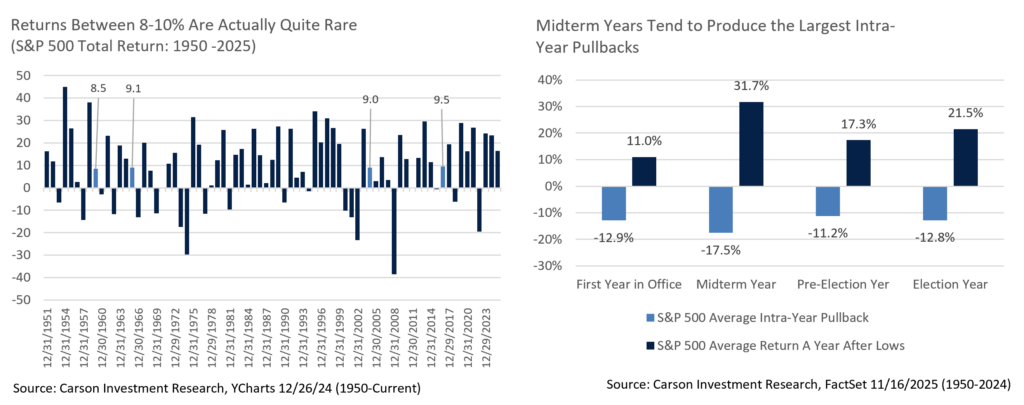
- Tis the season for sell-side analysts to look into their crystal balls and predict where the market will be a year from now. As of this writing, the average target for the S&P 500 stands at 7,550, which would represent a healthy gain of +10.3%. Since 1950, the average price return for the S&P 500 is +9.4%,which signals that analysts are slightly more bullish on 2026 but not going out on a limb. Ironically, the index has finished with a return of +8-10% only 4 times over that same timeframe, so while the average gain is +9.4%, we rarely ever actually get the average.
- Heading into the New Year, we remain constructive on equities but expect volatility to be elevated. The combination of supportive monetary policy, fiscal policy tailwinds, a growing economy, double digit corporate profit growth, benign credit conditions, and increasing capital expenditures on AI should fuel further gains. Inflation, interest rates, geopolitics, trade, achieving robust AI expectations, and elevated valuations are well known risks, and the unknown is often what ultimately causes the greatest downside risk. We are also mindful of the impact the Presidential cycle can have on markets, particularly given the current climate. Entering this midterm year, we wouldn’t be surprised to see increased volatility and possible downside pressure but recognize that such environments have historically proven to be attractive times to invest.
Sources: Bloomberg, FactSet
From the Trading Desk
Municipal Markets
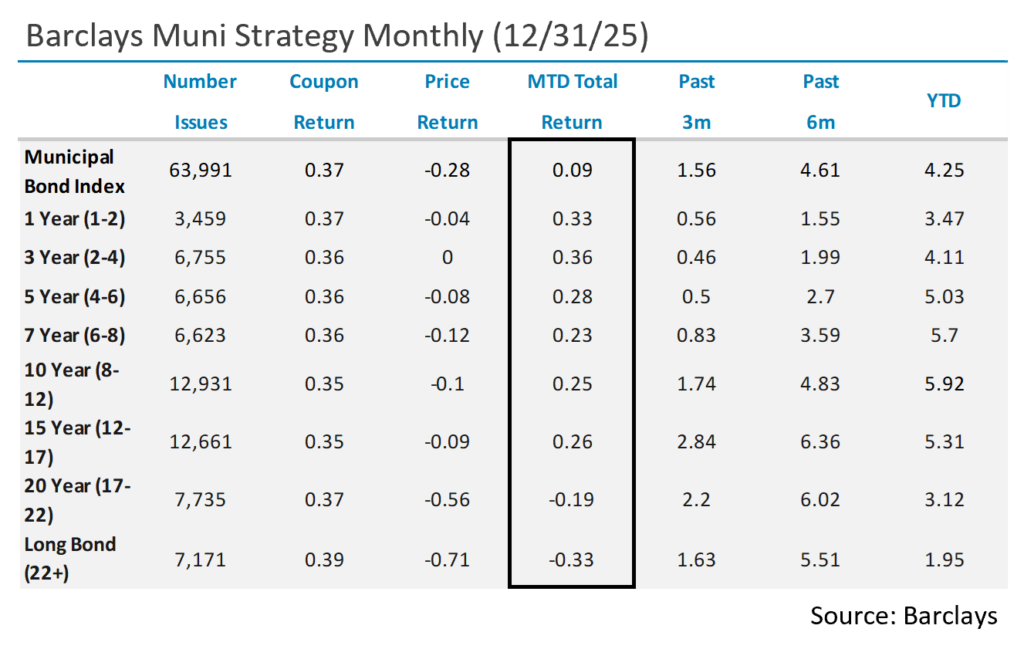
- While intra-month volatility in UST rates was evident (with an upward sloping bias), municipal rates remained relatively anchored in December despite the Fed action in the first half of the month. The curve sustained a slight steepening trend established in November, with the 2s-30s curve moving up in steepness by 13bps, while 2s-10s steepened by 6bps, and 2s-5s moved up 5bps.
- With regards to absolute yield levels, the 3-years and shorter portion of the curve saw yields move modestly lower, specifically by 4bps for 1-year issues and 5bps for 3-years. While the belly of the curve stayed flat, maturities of 10-years and longer saw yields push higher in an ascending manner. There was a modest 1bp increase from 10 to 12-year issues, while 15-year and longer maturities sustained more meaningful moves of 3 to 8bps.
- Municipal ratios remained within a relatively narrow range, although the trend was towards flat to slightly richer ratios across maturities. Ratios out to 3 years settled at 68%, while 5- and 7-year ratios closed the month just shy of 65%. The 10-year maturity settled at 67%, while the 30-year maturity closed at 87.5%
- According to JP Morgan, December gross issuance (largely focused in the first half of the month) totaled $37.9B, 21% higher than the same month of the prior year and a 31% increase relative to the trailing 5-year average. On a tax-exempt basis, supply totaled $35.9B, a 22% increase vs. December 2024. December closed out another record-breaking issuance year with the Bond Buyer reporting a total of about $580B in new issue volume, 13% ahead of 2024.
- Municipal fund demand has helped absorb this new supply, as December recorded $4B of net fund inflows. YTD flows are tracking at roughly +$50B, of which ETFs accounted for the bulk of the total ($35B).
Corporate Markets
- 2025’s Investment Grade Credit new issuance market will go down as the 2nd highest annual volume on record at $1.59T. This only trails the $1.75T brought to market during the acute uncertainty of the COVID pandemic and the ultra-low-interest rate environment of 2020. December’s $32.4B of issuance was much slower than the anticipated $40B, although a slow period around the holidays was expected. We are anticipating a flurry of issuance to begin 2026, with markets expecting a record of $1.80T to $2.25T. Of course, this is all dependent on variables such as Fed policy, the course of tariffs, macroeconomic news, and global tensions.
- High Yield issuance was also robust with spreads and overall yields presenting opportunities for issuers to capitalize on favorable funding conditions. Investor demand absorbed the $328.3B in new debt with ease. This year’s total was the 4th largest on record and continues a trend of higher YoY issuance since 2022. The $457.7B issued in 2021 was the largest yet on record and, if this trend continues, we could see issuance climb towards that level in 2026.
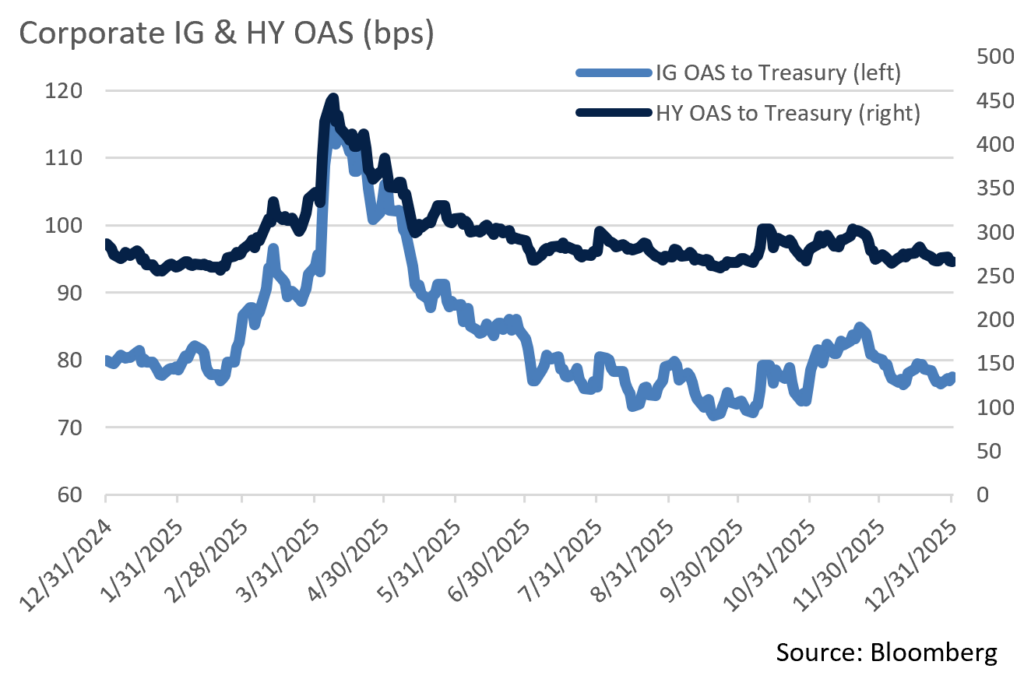
- While IG spreads began to move wider in November, they stayed in check over the course of December. The 80bps OAS recorded on the Bloomberg US Corporate Index only fell to 78bps to close out the year. That’s also just 2bps off where we began 2025. Looking back, the 119bps OAS of “liberation day” aftermath proved to be a short-lived anomaly. 2025’s average OAS was only 84bps, and the 72bps OAS print on September 19th was the lowest seen in at least 10 years. We could see some spread widening in 2026, especially if record setting issuance puts pressure on buyers and fatigue sets in. However, we don’t anticipate significant widening given the credit strength of issuers and the demand for yield and feel that IG spreads should remain in a comfortable range over the near term.
Sources: Bloomberg, Bond Buyer, Barclays, JP Morgan, and Lipper Inc.
Financial Planning Perspectives
Ten New Year’s Resolutions for 2026
The turning of the calendar offers us all an opportunity to reflect on the past year and to look forward with promise, hope and renewed aspirations. New Year’s Resolutions are commonly focused on personal habits or behaviors, although we feel those involving one’s financial well-being are also worthwhile. As we move into 2026, here are 10 Financial Resolutions to consider:
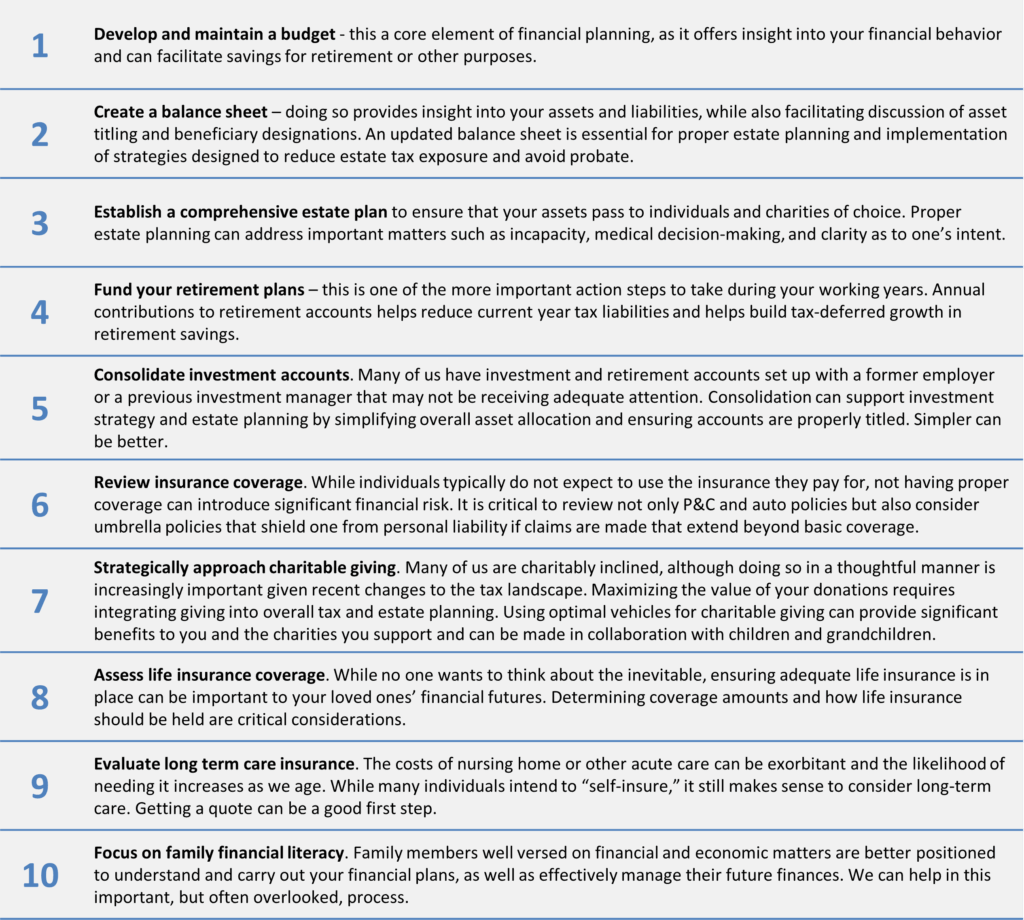
Appleton Wealth Management is eager to assist you with these and other financial planning matters. Please reach out to discuss your 2026 game plan. Happy New Year!
Source: Appleton Partners, Inc.
This commentary reflects the opinions of Appleton Partners based on information that we believe to be reliable. It is intended for informational purposes only, and not to suggest any specific performance or results, nor should it be considered investment, financial, tax or other professional advice. It is not an offer or solicitation. Views regarding the economy, securities markets or other specialized areas, like all predictors of future events, cannot be guaranteed to be accurate and may result in economic loss to the investor. While the Adviser believes the outside data sources cited to be credible, it has not independently verified the correctness of any of their inputs or calculations and, therefore, does not warranty the accuracy of any third-party sources or information. Specific securities identified and described may or may not be held in portfolios managed by the Adviser and do not represent all of the securities purchased, sold, or recommended for advisory clients. The reader should not assume that investments in the securities identified and discussed are, were or will be profitable. Any securities identified were selected for illustrative purposes only, as a vehicle for demonstrating investment analysis and decision making. Investment process, strategies, philosophies, allocations, performance composition, target characteristics and other parameters are current as of the date indicated and are subject to change without prior notice. Registration with the SEC should not be construed as an endorsement or an indicator of investment skill, acumen, or experience. Investments in securities are not insured, protected or guaranteed and may result in loss of income and/or principal.